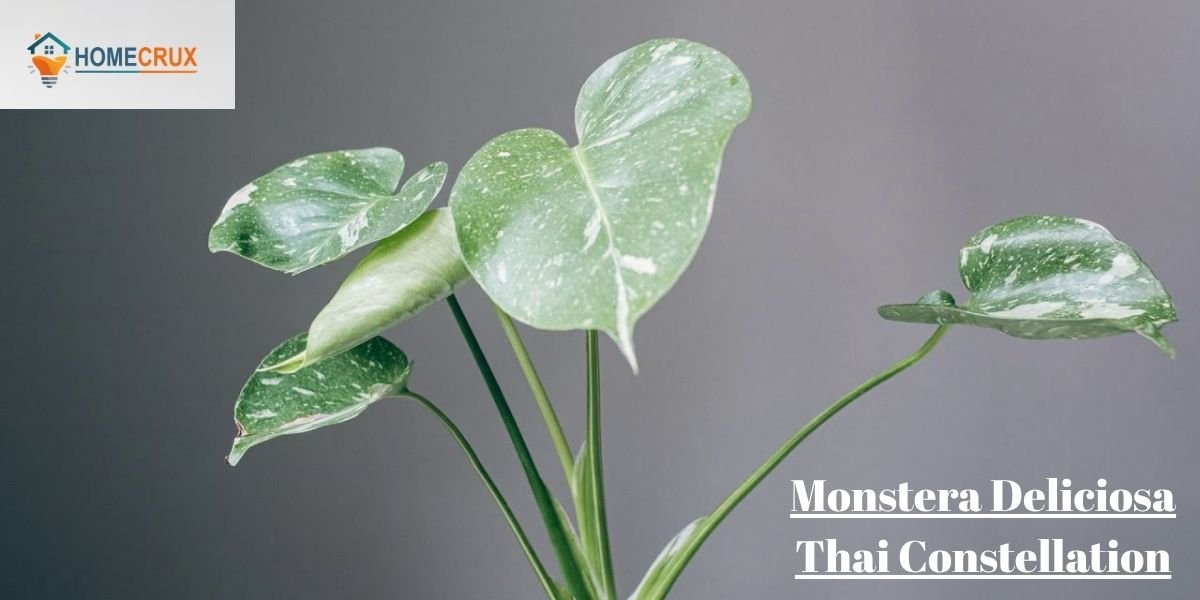
Let us skip the generic plant shop excitement and talk about what happens three weeks after you bring home a Monstera Deliciosa Thai Constellation. You paid a steep $150 to $250 for a healthy mid-sized specimen at a local boutique nursery, cleared space on your best West-facing bookshelf, and now you are staring down at a heavy emerald-and-cream leaf that refuses to grow a single millimeter.
This cultivar has taken the indoor gardening world completely by storm over the last several years, commanding legendary collector status because its splashy, cream-colored speckling mimics a starry night sky against deep forest-green tissue. Yet, first-time owners struggle constantly. They follow standard green Monstera care guides that recommend heavy watering and bright, direct sun, only to watch their prized investment develop root rot, brown crispy edges, or stagnant growth.
The core truth of growing a Thai Constellation indoors is that its striking variegation completely changes how the plant processes energy and handles environmental stress. Unlike the wild green species native to Central and South American rainforests, where climbing up massive tree trunks grants access to filtered canopy light, this laboratory-bred cultivar carries stable genetic traits that dilute chlorophyll across its foliage.
Understanding this biological difference is the single most important step to keeping your plant thriving. This practical guide is built directly on how the plant behaves inside a real home environment with real heating, cooling, and window light limitations.
What Makes Thai Constellation Different From a Standard Monstera Deliciosa
To grow this plant successfully, you need to understand its unique laboratory background. The Thai Constellation was never found climbing a wild tree in the jungle. It was originally engineered in a Thai tissue culture laboratory where scientists induced a stable genetic mutation.
Because of this laboratory heritage, the variegation is permanently locked into the plant’s DNA. Unlike a Monstera Albo Borsigiana, which can throw all-white leaves that eventually turn brown and die or revert entirely to solid green, a Thai Constellation maintains its creamy, splashed speckling across every single new node.
The biological trade-off for this stability is lower chlorophyll concentration. The creamy white patches on the leaves contain zero chlorophyll, meaning those specific parts of the plant cannot photosynthesize or create food.
This reduced functional leaf surface area directly dictates why growth is inherently slower than a standard green Monstera. A juvenile Thai Constellation might push out only three to four leaves a year in typical indoor room conditions, whereas a standard green counterpart can double its size in a single summer.
As the plant matures, its thick, woody stem grows sturdier, and its broad, glossy leaves begin to display natural fenestrations or internal holes that let light pass through to lower foliage. Recognizing that slow growth is a biological feature rather than a health crisis will save you from over-fertilizing or over-watering out of panic.
Start With a Healthy Plant
Many care problems begin long before the plant even reaches your living room. When shopping for a Thai Constellation online or at a local US plant nursery, resist the urge to buy the specimen with the highest amount of white or cream coloration.
While ghost-like leaves look stunning on social media feeds, plants with excessive white tissue struggle to generate enough energy to sustain themselves indoors. Look instead for balanced variegation where deep green sections are evenly distributed alongside the cream speckles.
Inspect the root system carefully if buying a potted plant. You want firm, white or light tan roots with active growing tips, rather than dark, mushy, or circling roots that indicate the plant has been sitting in a stagnant nursery pot for too long.
Avoid freshly imported unrooted cuttings unless you have advanced propagation setups with high humidity domes and heat mats. Established plants rooted in soil or chunky substrates adapt to indoor home environments far more reliably than raw cuttings trying to recover from shipping stress.
Check every stem node and the undersides of leaves for pests like thrips or spider mites, as variegated tissue is notoriously attractive to sap-sucking insects. Ensuring your starting specimen is robust gives you a massive head start.
Choose the Right Location Before You Think About Watering
Lighting dictates every other aspect of indoor plant care. Simply placing a plant near a window and calling it bright indirect light leads to inconsistent results.
South-facing and West-facing windows provide the intense light levels a Thai Constellation needs to fuel its reduced chlorophyll cells, but direct, harsh afternoon sun will scorch the delicate cream variegation, turning it translucent brown within hours.
East-facing windows offer gentle morning sun that the plant tolerates well, while North-facing windows rarely provide enough lumens to sustain healthy variegation over time.
If your windows are obstructed by trees or buildings, or if you live in a region with dark winters, using a full-spectrum LED grow light positioned twelve to eighteen inches above the plant for twelve hours a day changes everything.
Sheer white curtains act as a great filter if your only available spot blasts the plant with heavy afternoon rays. When a Thai Constellation receives too little light, the new leaves emerge smaller, leggy, and with muted, muddy variegation. When it receives too much unmitigated sun, the cream patches burn, leaving permanent scars.
Build a Soil Mix That Supports Healthy Roots
Standard potting soil from the hardware store is the enemy of indoor Monsteras. Heavy peat-based mixes retain water for far too long, suffocating the root system and setting the stage for fatal pathogens.
Root health relies entirely on oxygen availability. A proper indoor potting mix for a Thai Constellation must combine moisture retention with lightning-fast drainage.
- Orchid bark (coarse grade): Creates large air pockets throughout the pot so roots can breathe.
- Perlite or pumice: Improves drainage and prevents the soil mix from compacting over time.
- Horticultural charcoal: Absorbs impurities and keeps the root zone fresh.
- Coco coir or high-quality peat: Holds just enough moisture without becoming a dense sponge.
- Worm castings: Adds gentle, organic microbial life and light nutrients without burning delicate roots.
Mixing these components in equal parts ensures that when you water, excess liquid rushes through the drainage holes instantly while the bark and perlite retain the ideal micro-climate for root development.
Water According to Root Activity, Not the Calendar
Fixed watering schedules destroy indoor houseplants. Watering every seven days regardless of environmental conditions guarantees that your plant will eventually suffer.
Root activity shifts based on indoor humidity, ambient temperature, pot size, and the season. In the peak of summer, a growing plant in a warm room might drink its water in five days, while that same plant in winter might sit damp for three weeks.
To judge moisture correctly, stick your finger two inches into the soil mix or use a wooden moisture meter near the root ball. Never water a plant simply because the top surface looks dry.
Overwatering is rarely about the volume of water applied during a watering session. It is almost always caused by poor oxygen circulation around the root zone due to soil that stays wet for days on end.
Thirsty plants display slightly droopy stems and lighter soil weight, whereas waterlogged roots turn brown, lose their outer sheath, and emit a faint earthy rot odor. Always water thoroughly until it runs out the bottom drainage holes, and empty the catch saucer immediately.
Why Climbing Changes Everything
Many indoor growers treat Monsteras like trailing plants or shelf decorations, but this stunts their potential. In their natural habitat, they use strong aerial roots to climb vertical surfaces, which signals hormonal changes within the plant that trigger larger leaf sizes and deep fenestrations.
Providing structural support transforms how the plant develops.
- Moss poles: Keep the moss damp to encourage aerial roots to anchor directly into the support, mimicking a real tree trunk.
- Wooden planks: Offer a sturdy flat surface for thick stems to lean against naturally without rotting.
- Coco poles: Provide a durable, textured surface for aerial roots, though they hold less moisture than live moss.
As the main stem grows upward and locks onto a support, the apical meristem receives stronger structural signals, resulting in dramatic, dinner-plate-sized leaves with multiple rows of inner holes rather than small, juvenile, solid leaves.
Aerial roots can be gently guided into the soil pot or wrapped around your support pole; cutting them off entirely removes the plant’s natural stabilization mechanism and slows down vertical development.
Feeding a Slow-Growing Variegated Plant
Because a Thai Constellation grows more slowly than standard green tropicals, its nutritional demands are distinct. Dumping heavy synthetic fertilizers on the soil every two weeks leads to salt buildup that burns root tips and causes sudden leaf browning.
During the active growing season from spring through late summer, feed the plant every four to six weeks using a balanced liquid houseplant fertilizer diluted to half strength.
During autumn and winter, stop fertilizing entirely as natural daylight drops and the plant enters a period of semi-dormancy.
Adding slow-release organic granules into your spring soil mix provides a steady, low-dose supply of macronutrients without overwhelming the root system.
Watch out for nitrogen-heavy formulas, which can trigger rapid, unstable growth that produces weak stems incapable of supporting large, variegated leaves.
Understanding How Thai Constellation Grows Over Time
Managing your own expectations is a critical part of keeping this cultivar. During the first year indoors, a newly purchased plant focuses heavily on establishing its root system in its new environment, meaning you might only see one or two new leaves emerge.
The leaves will start out relatively small and heart-shaped. As the root mass expands and the plant climbs upward, subsequent leaves increase dramatically in size.
Fenestrations—the characteristic splits and holes—usually begin appearing once the plant reaches a maturity threshold where individual leaves receive enough light across their surface area to trigger genetic expression.
Patience is mandatory. Rushing the process with artificial heat or chemical stimulants usually backfires, resulting in weak, etiolated growth that collapses under its own weight.
Accepting that your Thai Constellation operates on a slower timeline allows you to enjoy steady, healthy progress rather than fighting the biology of the plant.
Repotting Without Interrupting Growth
Repotting an established indoor plant requires careful timing and precision. You should only repot when roots begin circling tightly around the bottom drainage holes or when water runs straight through the pot without absorbing into the soil mix.
Choose a new container that is only two inches larger in diameter than the previous one. Sizing up too quickly leaves a massive mass of uncolonized soil that retains moisture too long, leading directly to root rot.
Spring is the ideal season for repotting because the plant enters its active growth phase immediately after, helping it recover from transplant shock.
Gently massage the root ball to loosen old, compacted soil, trim away any dead or rotting black roots with sterilized shears, and position the plant at the exact same soil depth it previously enjoyed.
Avoid watering immediately if you trimmed significant root mass; let the plant rest for twenty-four hours to heal any microscopic cuts before giving it a thorough drink.
Keeping Variegation Healthy Instead of Simply White
Maintaining vibrant variegation requires a delicate balance between light and plant health. Many growers assume that maximizing white patches is the ultimate goal, but all-white leaves lack the cellular machinery required to feed themselves.
Over time, the plant will often sacrifice all-white leaves, letting them turn brown and die off because they drain more energy than they produce.
To keep the variegation stable and prevent the plant from reverting to solid green or dropping white sectors, ensure it receives consistent, bright, filtered light every single day.
Sudden drops in temperature or chronic over-fertilization can stress the plant, causing the green tissue to outgrow the cream sectors, resulting in muddy, blotchy patterns.
Clean dust off the leaves regularly with a damp microfiber cloth to ensure that every speck of functional green tissue can absorb maximum light indoors.
Solving the Problems Growers See Most Often
Indoor environments present unique hurdles that surface as visible plant stress symptoms. Diagnosing these issues requires looking at the pattern of damage rather than guessing at solutions.
- New leaves stay small: Caused by insufficient light levels or a root-bound container restricting expansion. Move the plant closer to a bright window or repot into a slightly larger vessel.
- Leaves stop splitting: Usually indicates a lack of vertical climbing support or inadequate light intensity. Provide a moss pole and brighter lighting.
- Brown edges develop: Triggered by low indoor humidity, tap water chemical buildup like fluoride, or erratic watering cycles. Flush the soil monthly with distilled water.
- Yellow leaves appear: A classic symptom of overwatering and suffocating roots. Check root health immediately and adjust your watering cadence.
- New growth emerges greener: Occurs when the plant is sitting in too much shade, forcing it to produce excess chlorophyll to compensate. Increase light exposure.
- Leaves curl downward: A sign of underwatering, heat stress from a nearby radiator, or severe root damage. Check soil moisture and ambient drafts.
- Growth suddenly stalls: Normal during winter, but concerning in summer. Check for root compaction or nutrient depletion.
- Root rot: Identified by mushy dark roots and a foul smell. Slash away rotted sections, sterilize, and repot in fresh chunky mix.
- Common indoor pests: Thrips and spider mites love variegated tissue. Inspect leaf joints weekly and treat proactively with insecticidal soap if spotted.
Seasonal Care Inside the Home
Indoor microclimates fluctuate wildly between seasons, requiring adjustments to your care routine. Winter heating systems dry out the air drastically, dropping indoor humidity down to twenty percent or lower, which causes crispy brown leaf tips on delicate cream variegation.
Running a dedicated humidifier near your plant during winter months keeps ambient humidity around fifty percent, satisfying its tropical requirements.
Summer brings intense heat and rapid evaporation, meaning your watering frequency will increase significantly compared to the rest of the year.
Watch out for cold winter drafts from leaky windows or hot summer blasts from air conditioning vents; sudden temperature swings shock the plant and halt new growth overnight.
Adjusting your placement as the angle of the sun shifts through your home ensures your Thai Constellation receives optimal light year-round.
Propagating Thai Constellation Successfully
Propagating a Thai Constellation is entirely possible, but patience is required due to the slow growth rate of the cultivar. Node placement is the single most critical factor for success.
You must cut a stem section that includes at least one healthy leaf, an active or dormant axillary bud, and a visible aerial root node. Water propagation works well for beginners, allowing you to watch root development closely in a glass of clean water changed weekly.
Alternatively, moist sphagnum moss or perlite inside a clear propagation box provides excellent humidity and oxygen balance for root initiation.
Expect root emergence to take anywhere from four to eight weeks, significantly longer than a standard green Monstera.
Do not transplant the cutting into a chunky soil mix until the secondary roots are at least two inches long and branching out robustly.
Is Thai Constellation a Good Choice for Beginners?
An honest evaluation of this plant is necessary before making a purchase. In terms of cost, Thai Constellation plants command a much higher price tag than standard houseplants—ranging from $80 to $180 for small rooted cuttings and scaling up to $180 to $400+ for established juvenile specimens—meaning mistakes carry a financial penalty.
The maintenance level is moderate to high because of its sensitivity to overwatering and light fluctuations. The learning curve involves understanding the unique biology of variegated tissue and resisting the temptation to fuss over it daily.
If you are a beginner who tends to overwater plants or lacks access to bright indoor lighting, you might want to start with a standard Monstera Deliciosa or a hardy Pothos to master basic tropical care principles first.
However, if you are patient, attentive, and willing to invest time in setting up proper soil and lighting, a Thai Constellation makes a rewarding centerpiece collection plant that thrives indoors for decades.
Frequently Asked Questions
Why is my Thai Constellation growing so slowly?
Slow growth is entirely natural for this cultivar due to its genetic mutation and reduced chlorophyll content. As long as new leaves are healthy and your root system is sound, low annual leaf output is normal.
Can Thai Constellation live in low light?
No. Low light causes the plant to drop its variegation intensity, stretch out internodal spacing, and eventually decline because the reduced green tissue cannot photosynthesize effectively in dark corners.
How often should I water it indoors?
Water only when the top two to three inches of your chunky soil mix feel completely dry to the touch. This typically ranges from every seven to fourteen days depending on your indoor temperature and pot size.
Why are new leaves smaller than older ones?
Smaller new leaves usually indicate that the plant lacks adequate light intensity or needs structural climbing support to signal proper maturation hormones.
Does Thai Constellation need a moss pole?
While it can survive without one, providing a vertical climbing support dramatically improves leaf size, fenestration development, and overall structural strength.
Can the white parts of the leaves turn green?
No. Once a leaf unfurls, its genetic variegation pattern is fixed. However, inadequate light can cause new emerging leaves to display heavier green dominance.
When should I repot a Thai Constellation?
Repot every two to three years in spring, only when root crowding becomes visible at the base drainage holes or when soil compaction stops water absorption.